Giỗ Tổ Hùng Vương
Giỗ Tổ Hùng Vương (Commemoration of Hùng Vương) - A Special Spiritual Resource
Giỗ Tổ Hùng Vương is not only a ritual commemorating our origins but also an enduring spiritual bond across the historical stages of the nation, awakening the consciousness of compatriots, the spirit of nation-building, and the solidarity and unity of the country.
Giỗ Tổ Hùng Vương - A Special Spiritual Resource
In the Vietnamese consciousness, the journey to one's roots is never a closed chapter. It remains an underground current of national memory, connecting the present to the primordial era of nation-building.
Every third month of the lunar calendar, as nature transitions to summer, millions of hearts turn toward Giỗ Tổ Hùng Vương - a sacred milestone of faith and identity.
In old newspaper pages, the nation's origin story was recounted simply yet profoundly: "Kinh Dương married the daughter of Động Đình, giving birth to Sùng Lãm, titled Lạc Long Quân. Lạc Long Quân married Lady Âu Cơ (daughter of King Đế Lai), begetting one hundred sons... Of those one hundred sons, Lạc Long sent half to the forests and half to the sea. Multiplying day by day over nearly five thousand years, they formed such a vast nation" (Hà Thành Ngọ Báo, March 29, 1935).
This legend has endured in spiritual life across generations, serving as a reminder of a shared origin. From this very wellspring, the Giỗ Tổ is not merely a commemorative ritual but a spiritual fulcrum, where past and present converge in the consciousness of "đồng bào" (compatriots) - a term both sacred and intimate.
Giỗ Tổ Hùng Vương has long been a space for cultural convergence, where national memory is vividly recreated through each festival season. Journalistic records from the early 20th century help us better envision the festive atmosphere in the Ancestral Land - both solemn and bustling. In its April 10, 1930 issue, Hà Thành Ngọ Báo painted a vivid picture of the festival: "Every year, on the 10th of the third lunar month, the festival of Đền Hùng (Hùng temple) takes place. The temple (đền) is built atop a towering mountain in Hy Cương village (Phú Thọ province). Looking from afar, one sees only dense trees, a deep green…
Every year, as the festival approaches, intersections and main roads are packed with devout men and women flocking to worship. The paths leading to the railway station are particularly crowded. Every train is packed with festival-goers; the Railway Department has to attach additional carriages to transport passengers. The ticket clerks cannot sell tickets fast enough... Various games are set up everywhere, creating a jubilant and joyful atmosphere, such as the Eight Immortals swing (du bát tiên), human chess (cờ người), wrestling (đánh vật),…” (Hà Thành Ngọ Báo, April 10, 1930).
Associated with the spirit of national construction
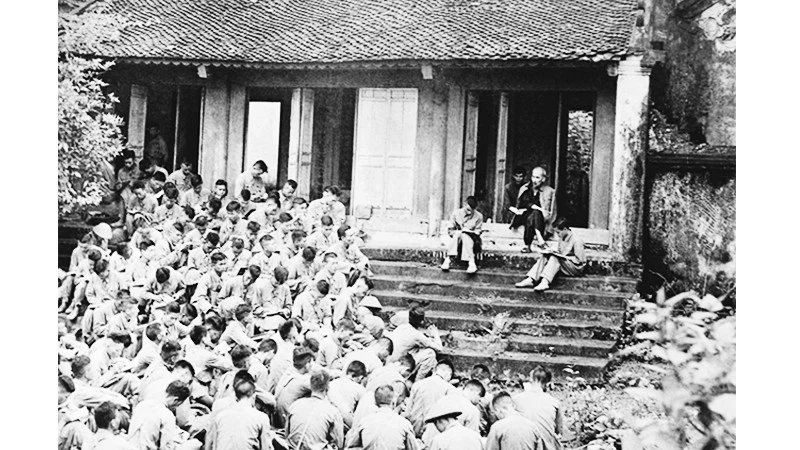
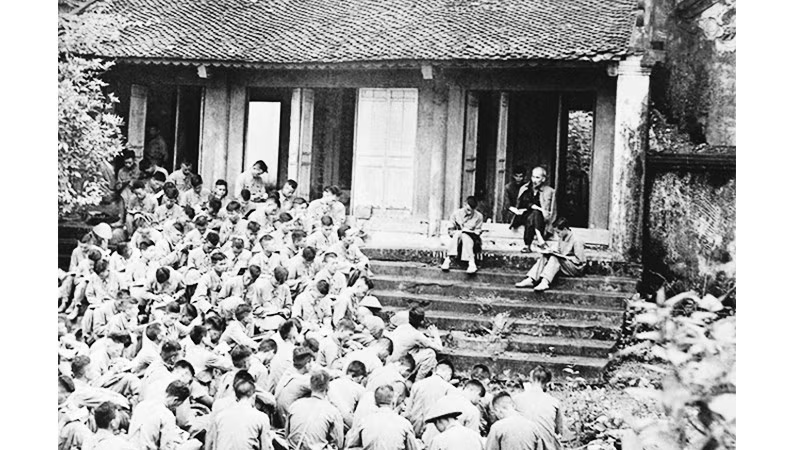
In the very first year of the Democratic Republic of Vietnam (Việt Nam Dân chủ Cộng hòa), when the revolutionary government was still facing countless difficulties, the establishment and honoring of the nation's fundamental values were initiated early on. On February 18, 1946, President Hồ Chí Minh signed Decree No. 22/SL-CTN on Tết holidays, historical anniversaries, and religious festivals, including Hùng Vương Day (the 10th of the 3rd lunar month). Accordingly, public offices nationwide would be closed; daily-wage public servants working at these offices were entitled to receive their salary on Hùng Vương Day.
In the context of the newly independent country, the Hùng Kings' Commemoration Day (Giỗ Tổ Hùng Vương) took on a new appearance - tied to the spirit of national construction and the will for national unity. The Cứu Quốc (National Salvation) newspaper issue on April 13, 1946, depicted the special atmosphere of that year's commemoration season at the Hùng Temple (Đền Hùng):
“The 10th of the 3rd lunar month: the Ancestral Commemoration Day (ngày giỗ tổ). This year's commemoration day across Vietnam was celebrated solemnly in every province, mostly following a new ritual. At the Hùng Temple (Đền Hùng) in Phú Thọ province, where their mausoleums are located, the festival was also very different from previous years. Under the red flags with yellow stars fluttering in the wind and stretching themselves over tall trees on the high mountain, there was a war and anti-illiteracy photography exhibition here, and a booth displaying books, newspapers, and portraits of Uncle Hồ there. There were also national construction gift stalls organized by the 'Women for National Salvation' (Phụ nữ cứu quốc) sisters... Numerous slogans: Unified Vietnam, Long live the Fatherland, Ready to obey President Hồ's orders... were hung across all the paths from the foot to the peak of the mountain.
On the 9th, National Assembly and Government delegates arrived, and cheers resounded all day long. That day, at a rally of tens of thousands of Kinh, Mán, and Mường people at the foot of the mountain, Mr. Huỳnh Thúc Kháng - Minister of the Interior, and Mr. Nguyễn Văn Tố - Chairman of the National Assembly Standing Committee took the podium to speak about the significance of this year's commemoration day and urged the people to unite. Mr. Nguyễn Xiển - Chairman of the Northern Administrative Committee urged all people in the province to participate in dike repair, especially the dike sections in Lâm Thao and Hà Kỳ, which required the efforts of both the Government and the people to prevent the upcoming flood waters. Finally, the Chairman of Phú Thọ province majestically concluded the rally.
On the morning of the 10th, the main commemoration day,… before the Fatherland altar on the high mountain peak, surrounded by dense trees from the Inner Temple (Đền Trong) up to the Upper Temple (Đền Thượng), the Minister of the Interior, the Chairman of the National Assembly Standing Committee, and the Chairman of the Northern Administrative Committee acted as ritual assistants (bồi tế). However, in this ceremony, we also noticed a very meaningful gesture: the Government and National Assembly delegates offered a map of a unified North, Central, and South Vietnam and a red flag with a yellow star on the Fatherland altar, filling everyone with sacred thoughts about the country. And perhaps everyone silently swore in their hearts: determined to firmly defend the nation and protect the flag…” (Cứu Quốc newspaper, April 13, 1946).
The spiritual thread connecting North and South
Even in the historic April days of 1975 - when the fighting spirit was spreading nationwide and the country faced the moment of reunification - the Hùng Kings' Commemoration Day (Giỗ Tổ Hùng Vương) was still solemnly held in the Ancestral Land (Đất Tổ), acting as a resilient spiritual pillar of the nation. According to Nhân Dân newspaper (issue dated April 21, 1975), on the morning of April 20 (the 10th of the 3rd lunar month), in Hy Cương commune, Lâm Thao district, Vĩnh Phú province, local authorities and mass organizations solemnly held the Commemoration Ceremony, with the participation of numerous officials and people. In the context of the whole nation looking towards the South, towards the day of total victory of the Hồ Chí Minh Campaign, this event carried an even more special significance: It served as a reminder of common roots, of the unbroken historical connection of a nation approaching its day of reunion.
Just over a month after the country's complete reunification, amidst the joyful atmosphere of a new era, reflecting on the nation's origins quickly became a profound spiritual need. On June 8, 1975, in Sài Gòn, the exhibition "Hùng Vương dựng nước" (Hùng Vương Founding the Nation) opened. It carried a clear message: the period from the early days of nation-building to national reunification forms a seamless historical flow. "Opening the 'Hùng Vương dựng nước' exhibition in Sài Gòn: On the morning of June 8 in Sài Gòn, the 'Hùng Vương dựng nước' exhibition, relocated by Viện Bảo tàng Lịch sử Việt Nam (National Museum of Vietnamese History) to serve the people of Sài Gòn - Gia Định, officially opened. Featuring numerous documents and over 300 artifacts from four archaeological groups—Phùng Nguyên, Đồng Đậu, Gò Mun, and Đông Sơn—representing four brilliant periods of cultural development in the Hùng Vương era, the exhibition introduces our nation's tradition of building and defending the country... President of the Provisional Revolutionary Government of the Republic of South Vietnam Huỳnh Tấn Phát and Vice President Phùng Văn Cung visited the exhibition, as did ambassadors and foreign representatives in Sài Gòn" (Nhân Dân, June 11, 1975).
Looking back at these historical fragments, Giỗ Tổ Hùng Vương (Hùng Kings' Commemoration) emerges as a persistent, continuous "thread of memory." Despite varying historical circumstances, it consistently maintains a constant: the awareness of origins and community cohesion. What is remarkable is not just the preservation of a tradition, but how each era has "re-signified" it. In traditional society, Giỗ Tổ was an occasion to commemorate ancestors. In the early years of an independent nation, it became a rallying cry for solidarity. During the period of national division, it served as a spiritual tie connecting the North and the South. When the country was finally reunified, it transformed into a symbol of historical and cultural unity.
Therefore, the greatest significance of Giỗ Tổ Hùng Vương lies in its ability to awaken a profound realization: every Vietnamese person, regardless of location or circumstance, shares a common origin. The term "đồng bào" (compatriots) is not merely an appellation, but a moral foundation. Once awakened, this awareness becomes a unique spiritual resource. It helps people overcome divisions and differences to pursue greater shared values.
In today's context of rapid social change, traditional values face numerous challenges. Thus, reflecting on Giỗ Tổ Hùng Vương is not merely an act of nostalgia. It also poses a critical question for the present: how can this heritage be transmitted vividly and accessibly, especially to the younger generation? The answer lies not in slogans, but in creative approaches, in-depth historical education, and cultural spaces where the past can "dialogue" with the present. Ultimately, a nation is only truly resilient when it retains its memory.
Tác giả
Báo Nhân Dân điện tử
